Usha Janome Dream Maker 120 Review: A Feature-Rich Computerized Sewing Machine, but Reliability and Support Deserve Attention
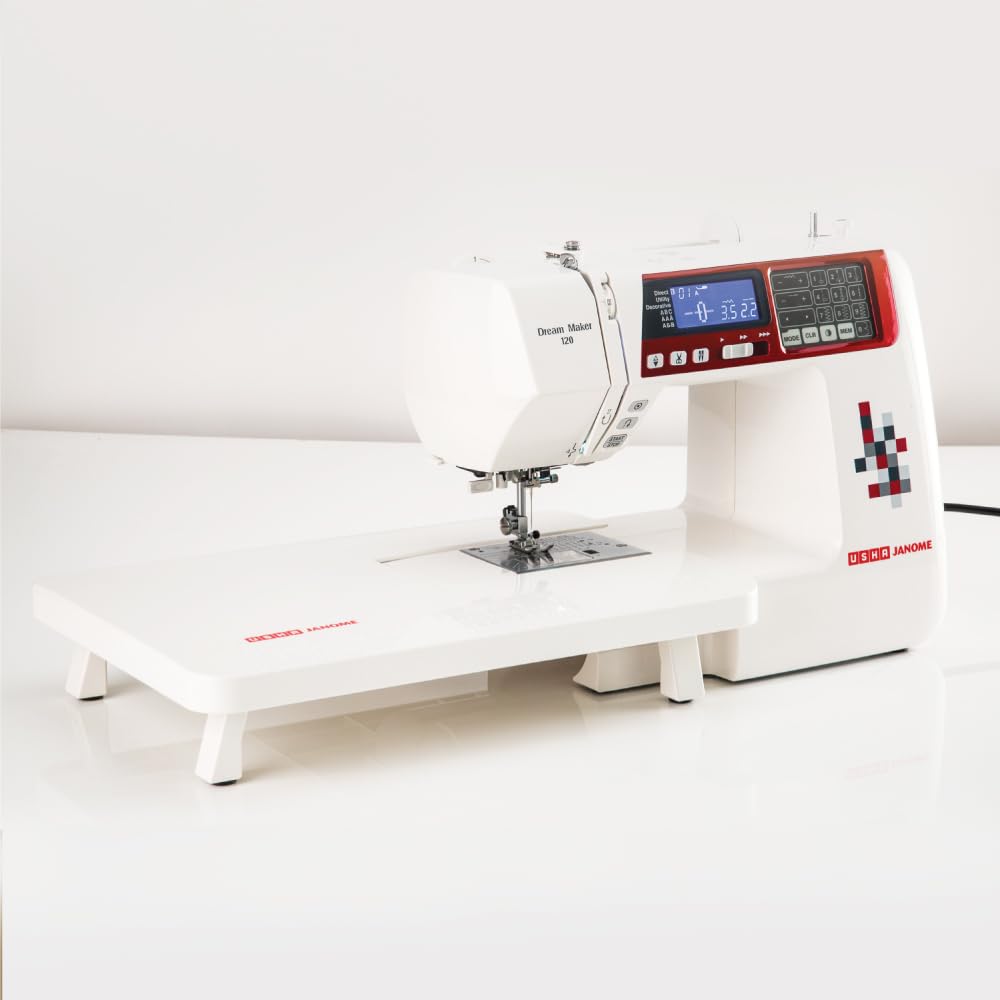
The Usha Janome Dream Maker 120 sits well above a basic home sewing machine. Its appeal is easy to understand: 120 built-in stitches and alphabets, an LCD screen, direct stitch selection, adjustable speed, start/stop sewing without relying on the foot pedal, drop feed, an extension table and several convenience features designed to make creative sewing easier.
That combination makes the Dream Maker 120 interesting for hobby sewing, garment work, decorative projects and small home-boutique use. Customer feedback also shows that many owners genuinely enjoy the machine’s stitch quality and creative flexibility.
However, this is not a machine to buy purely because the feature list looks impressive. The customer feedback also contains recurring reports involving missing accessories or warranty documentation, demonstration and service difficulties, and occasional functional failures. The Amazon review snapshot reflects that divided experience: 62% of ratings are five-star, but 16% are one-star.
The result is a capable computerized machine that can be very rewarding for the right owner, but the condition of the delivered unit and access to dependable after-sales support matter almost as much as the specifications.
Check the Usha Janome Dream Maker 120 Price and Availability on Amazon
What Makes the Dream Maker 120 Different From a Basic Sewing Machine?
The biggest difference is not simply that it has more stitches. It gives the user much more electronic control over how the machine operates.
The listing specifies:
- 120 built-in stitches and alphabets
- LCD display with direct stitch selection
- speed-control slider
- start/stop operation without the foot control
- locking-stitch button
- built-in thread cutter
- extension table
- seven-piece feed dog
- drop-feed capability
It also lists an automatic thread trimmer, up to 7 mm stitch width, mirrored editing and programming for combinations of up to 50 patterns.
Those are meaningful additions rather than decorative specifications.
For example, variable speed control can make detailed work considerably easier because the user can deliberately slow the machine down instead of controlling everything through pedal pressure. The start/stop button also means the machine can sew without the foot pedal, which several owners found particularly convenient.
One detailed owner specifically highlighted the ability to sew without the pedal and regarded the start/stop control and thread-cutting functionality as useful for someone still learning the machine.
For a person moving from a traditional mechanical machine, these conveniences are likely to be among the first improvements they notice.
The Strongest Part of the Machine Is Its Creative Flexibility
The Dream Maker 120 makes the most sense when its decorative and computerized functions will actually be used.
A basic machine can already handle routine straight stitching, alterations and many normal garment jobs. Paying considerably more for the Dream Maker 120 becomes easier to justify when the owner intends to experiment with decorative stitches, different presser feet, pattern combinations and more advanced creative sewing.
The included stitch selection covers both functional and decorative work. The machine can also create alphabets, which expands its usefulness for personalization and craft projects.
Longer-term customer feedback supports this use case. One owner who waited around a year before reviewing described it as suitable for home-boutique use and useful for a wide variety of projects. That same owner found the machine sturdy overall, although the needle threader could sometimes be finicky.
Another more recent user, after upgrading from a basic Singer, particularly appreciated being able to see the bobbin, the automatic needle position controls and adjustable sewing speed.
That gives a clearer picture of where the Dream Maker 120 earns its premium: not simply by offering 120 stitch choices, but by making experimentation and controlled sewing more convenient.
Stitch Quality Gets Some Very Positive Feedback
The machine’s stitch output is one of the more encouraging parts of the customer feedback.
A 2025 reviewer who had experience with Singer machines described the Dream Maker 120’s stitch and embroidery-style design output as particularly sharp and neat.
Another owner praised the quality of the designs produced by the machine, although that same person felt the model could be difficult for complete beginners to understand initially.
That distinction is useful.
The Dream Maker 120 can produce sophisticated-looking work, but owning a computerized machine does not automatically remove the learning process. Users still need to understand stitch selection, presser feet, thread tension, fabric handling and when different functions are appropriate.
There is also one expectation worth correcting: a customer noted that the decorative stitches appeared smaller in actual use than expected from promotional video material, even at the maximum selected size.
Anyone buying primarily because they expect very large decorative patterns should keep that limitation in mind.
Is the Usha Janome Dream Maker 120 Good for Beginners?
The answer is more nuanced than simply yes or no.
Several buyers found it easy to learn. One early detailed review said the machine was simple enough to set up and begin using without previous experience, helped by the electronic start/stop system.
Another customer said a family member was able to learn the basics after spending a few hours with it.
Other owners, however, had the opposite reaction. One explicitly said they would not suggest it for beginners because it was difficult to understand, despite otherwise liking the machine.
Both experiences can be true.
A beginner who is comfortable following instructions, experimenting with controls and learning gradually may find the adjustable speed and start/stop operation helpful.
Someone who wants an extremely simple machine with a handful of knobs may feel overwhelmed by 120 stitches, multiple presser feet and computerized settings.
Usha’s listing also directs owners to its sewing resources for lessons and step-by-step guidance and provides a method to connect for queries or a demo.
The machine is therefore beginner-capable rather than beginner-minimalist.
The Included Accessories Add Real Value — but Check Them Immediately
The official listing describes a fairly substantial accessory package, including multiple presser feet, bobbins, a seam ripper, needle set including a twin needle, spool accessories and a screwdriver.
For someone who intends to explore the different stitch functions, having the appropriate feet included is useful. One 2025 customer specifically said the supplied feet covered their needs without requiring immediate additional purchases.
Unfortunately, the customer feedback makes one practical buying step especially important:
Inventory everything as soon as the package arrives.
There are several complaints involving missing items. One buyer reported receiving the machine and manual but not the expected built-in accessories.
Another specifically reported that the automatic buttonhole foot was missing.
There are also multiple older reviews complaining about a missing warranty or guarantee card.
Those reports do not mean every box will be incomplete. Many customers received their machines properly packed with the accessories they expected. But because this is an expensive purchase, checking the box against the current contents list immediately is sensible.
Do not wait several weeks before discovering that an accessory or document is missing.
View the Current Dream Maker 120 Listing and Included Accessories on Amazon
Reliability Is the Biggest Reason Not to Buy Blindly
This is the area where the Dream Maker 120 deserves the most scrutiny.
Amazon’s own customer-feedback summary describes quality and ease of use positively but identifies reliability as an area of concern, with value-for-money opinions also divided.
The individual reviews explain why.
There are reports of:
- machine functions failing
- power problems
- decorative modes producing incorrect patterns
- buttons not functioning
- machines needing repeated repair
- issues appearing soon after purchase
One owner described a machine that initially worked but later developed repeated problems despite service visits.
A 2025 buyer reported the machine losing power within roughly 15 days and was unhappy with the resolution.
A 2024 customer reported incorrect stitching from one embroidery/design mode and initiated a replacement.
Another buyer complained of receiving a scratched, apparently previously opened machine with non-functioning buttons. That appears to be an isolated delivery-condition complaint rather than evidence that all units are supplied that way, but it reinforces the importance of inspecting an expensive machine immediately after delivery.
This does not cancel out the many customers who have successfully used and enjoyed the Dream Maker 120. It does, however, make the purchase less straightforward than the feature list suggests.
For a ₹40,000-plus computerized appliance, good after-sales support matters much more than it would on an inexpensive basic machine.
After-Sales Support Is the Other Major Concern
Several of the more critical reviews are not complaints about stitch quality at all. They are complaints about what happened when help was needed.
Buyers have reported difficulties arranging demonstrations, long waits for technicians and unsatisfactory responses from customer support. One customer described waiting after repeatedly requesting technical assistance; another complained that a free demonstration had not been properly handled.
Additional reviewers also described poor experiences when trying to arrange a demo or obtain service.
Service quality can vary substantially by location and time, so these reviews should not be interpreted as proof that every owner will experience poor support.
They do reveal an important buying consideration, though:
Check how easily Usha sewing-machine service is available in your area before purchasing.
For someone living in an area with dependable Usha/Janome service access, the risk is easier to accept. For someone far from authorized support, a computerized machine with occasional electronic complaints becomes a more consequential purchase.
Speed and Power May Not Suit Every Type of Sewing
Not every criticism concerns reliability.
A few owners simply wanted the machine to be faster or more powerful. One described the speed as slow, while another said the sewing speed was insufficient.
Another buyer liked the stitching but wished the machine had more power.
That suggests the Dream Maker 120 should be viewed primarily as a feature-rich domestic computerized machine, not as a substitute for a high-speed industrial sewing machine.
For hobby work, boutique-style creative sewing, garment making, quilting-related projects and decorative work, controlled speed can actually be helpful.
For someone whose priority is maximum throughput on repetitive stitching, the extensive computerized functionality may be less valuable than a simpler but faster or heavier-duty machine.
A Small Feature That Makes a Surprisingly Big Difference: Speed Control
Among the Dream Maker 120’s many features, variable speed control may be one of the most useful in daily operation.
The listing explicitly provides a speed-control slider and start/stop sewing without the foot pedal.
That matters when:
- sewing around curves
- positioning decorative stitches
- learning a new technique
- working on smaller pieces
- trying to maintain accuracy
- using the machine without comfortable access to a foot pedal
A recent upgrader from a basic machine singled out variable speed as one of the functions they particularly appreciated.
It is the kind of feature that may seem secondary on a specification sheet but can become one of the reasons a computerized machine feels easier to control.
One Minor Detail Quilters Should Know
A 2025 owner liked the machine overall but felt the 1/4-inch seam allowance could be marked more clearly.
That is a small criticism, but it is relevant for quilting and other work where consistent seam allowance matters.
The package specification does include a 1/4-inch seam foot, which helps compensate for that issue.
It is therefore more of a usability annoyance than a fundamental limitation.
What the Customer Ratings Actually Suggest
The overall rating shown in the supplied Amazon material is 4.0 out of 5 from 165 global ratings, with:
- 62% five-star
- 17% four-star
- 2% three-star
- 3% two-star
- 16% one-star
That distribution tells a more useful story than the average score alone.
Most ratings fall in the positive end of the scale, and many owners praise the sewing experience, creative options and ease of use.
But the relatively substantial one-star share should not be ignored. The negative reviews are not all complaining about minor preferences; several involve machine functionality, incomplete deliveries or customer support.
So the Dream Maker 120 appears to have a high satisfaction ceiling but also a meaningful ownership-risk tail.
In other words, getting a properly functioning unit can result in a very capable and enjoyable machine. Getting a problematic unit makes service quality critically important.
Read More Customer Feedback and Check the Latest Price on Amazon
Who Is the Usha Janome Dream Maker 120 Best Suited To?
This machine is particularly compelling for someone who has outgrown a basic sewing machine and wants to explore more creative work without stepping into a professional industrial setup.
It should suit:
- serious home-sewing enthusiasts
- people upgrading from a basic mechanical machine
- home-boutique and craft users
- users interested in decorative stitching and alphabet functions
- sewists who appreciate electronic speed control
- users who want start/stop sewing without relying entirely on a foot pedal
- people likely to make use of multiple presser feet and computerized functions
One long-term owner specifically described it as suitable for home-boutique work and a wide range of projects.
It is harder to justify for someone who only wants straightforward repairs, hemming and occasional straight stitching. Much less expensive machines can perform those tasks without the added complexity or cost.
It may also be less suitable for someone who needs industrial-level speed, or who has poor access to authorized sewing-machine service.
Is the Usha Janome Dream Maker 120 Worth the Money?
The listing captured in the supplied product material showed the machine at ₹44,499 against an MRP of ₹46,999.
At that level, value depends heavily on how many of its advanced capabilities will actually be used.
For a person who wants:
straight stitch + zig-zag + occasional repairs, the Dream Maker 120 is likely excessive.
For someone who values:
120 stitches, alphabets, electronic speed control, direct stitch selection, pattern combinations, drop feed, numerous included feet and creative sewing flexibility, the premium has a much clearer purpose.
The customer reviews reflect exactly that split. Some owners regard the machine as highly worthwhile, while others feel the cost is difficult to accept when reliability or support problems occur. Amazon’s own review summary also notes that value-for-money sentiment is mixed.
Final Assessment
The Usha Janome Dream Maker 120 is one of those products where the specification sheet explains only half of the purchase decision.
Its strengths are substantial. It offers an unusually broad stitch selection, computerized control, useful speed adjustment, foot-pedal-free operation, multiple sewing feet and enough creative functionality to keep an enthusiastic home sewist occupied for a long time. Positive owners describe neat stitching, convenient controls and suitability for serious hobby or boutique-style sewing.
The caution comes from the ownership experience. Reports of missing accessories, warranty-document issues, malfunctioning features and frustrating service experiences appear often enough that they should affect how the machine is purchased.
A sensible buyer should therefore do three things:
- Confirm local Usha/Janome service availability before ordering.
- Inspect the machine, accessories and documentation immediately after delivery.
- Test the major computerized functions while the applicable replacement/return window is still open.
For a buyer who will genuinely use its creative functions and has dependable service access, the Dream Maker 120 can be a meaningful upgrade from a simpler machine. For someone who prioritizes simplicity, maximum speed or trouble-free servicing above advanced stitch options, a less complex model may be the safer fit.
Check Current Availability, Price and Seller Details for the Usha Janome Dream Maker 120