Jack F5 Sewing Machine Review: A Serious Industrial Machine for Tailoring, High-Speed Work and Daily Production
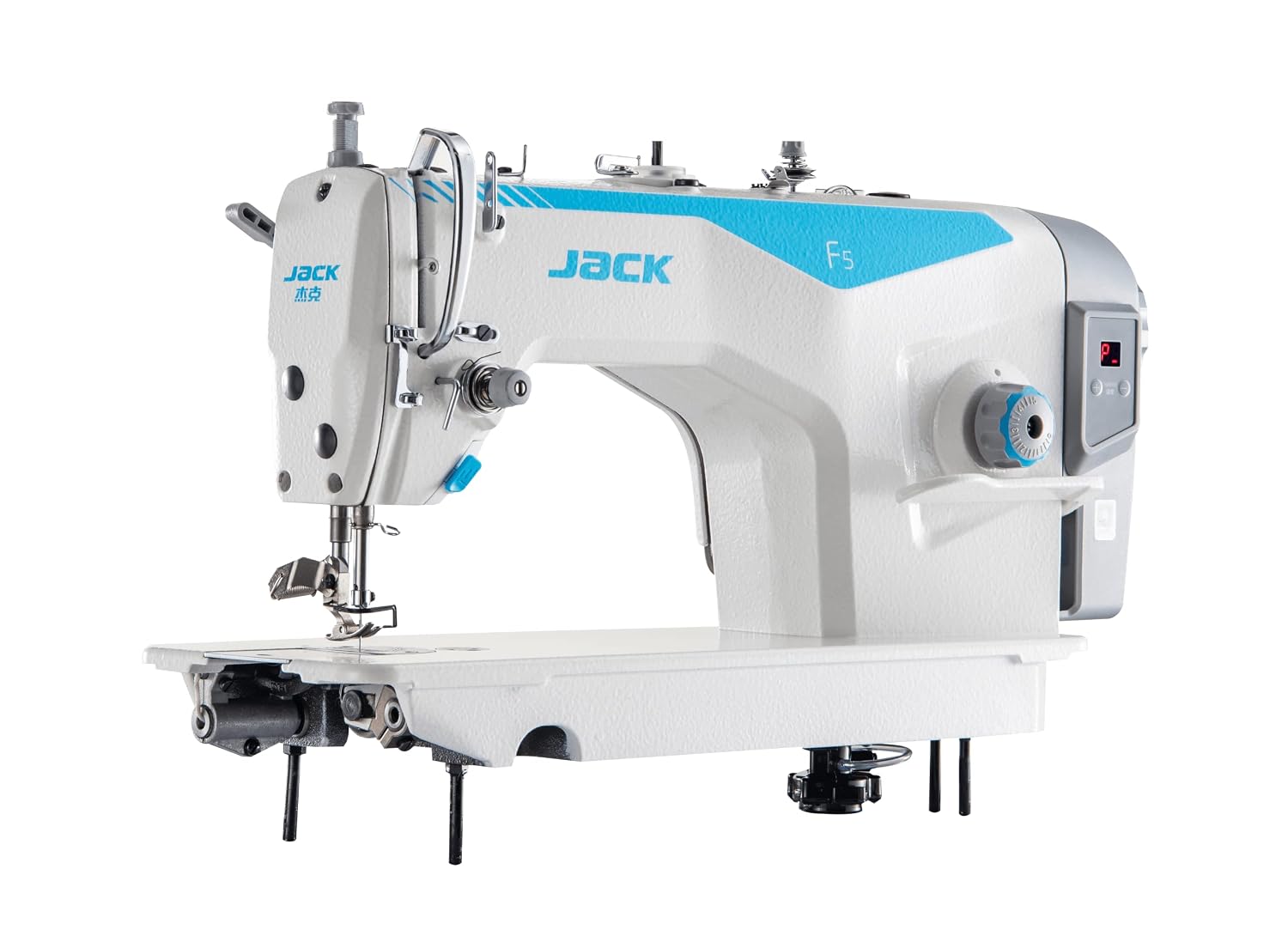
The Jack F5 Industrial Professional Sewing Machine is fundamentally different from the portable electric sewing machines typically bought for occasional household repairs.
This is a full-size industrial machine designed around speed, continuous work, precise straight stitching and professional tailoring. It combines an integrated energy-saving motor with electronic controls, needle-position functions, LED work lighting and a large industrial table setup.
That distinction matters because the Jack F5 makes little sense for someone who simply wants to repair clothes a few times per month. Its size, approximately 50 kg listed weight, assembly requirement and industrial format are excessive for casual sewing.
For a tailor, alteration shop, boutique, fashion student moving into serious production, or home-based sewing business, however, those same characteristics become its biggest advantages.
The limited customer feedback available for this exact Amazon listing is notably positive about stitch quality, smooth running and control across faster and slower sewing speeds. The bigger questions are purchase price, seller selection, assembly, available service, and whether an industrial straight-stitch machine actually matches the work you plan to do.
Check the Jack F5 current price and availability on Amazon
The Jack F5 Is an Industrial Machine, Not a Feature-Packed Domestic Sewing Machine
The easiest mistake is comparing the Jack F5 with domestic Singer, Usha or Brother machines based on the number of stitch patterns.
That comparison misses the point.
Domestic machines often advertise:
- zig-zag stitches,
- decorative patterns,
- buttonholes,
- stretch stitches,
- built-in stitch selectors,
- portable construction.
The Jack F5 is aimed at a different priority: doing core sewing work quickly, repeatedly and accurately in a production-oriented environment.
Its product description positions it as a professional machine suitable for high-production environments and includes an integrated motor, electronic controls, needle up/down positioning, LED illumination and other functions intended to make repeated sewing more efficient.
For someone producing garments every day, consistency and workflow can matter far more than having dozens of decorative stitches.
Smooth Stitching Is the Most Encouraging Real-World Feedback
One of the clearest themes in customer feedback is smooth sewing.
A verified purchaser specifically described the stitching as smooth and the machine as good quality.
Another verified owner praised the quality of the finished stitching and indicated satisfaction with how the machine performs across fast and slow operation.
That is exactly the type of feedback that matters for an industrial machine.
A professional sewing machine can have an impressive specification sheet, but it becomes frustrating very quickly if:
- acceleration is difficult to control,
- stitching becomes inconsistent at speed,
- the motor feels rough,
- the machine vibrates excessively,
- or slow precision work is difficult.
The early feedback on the Jack F5 is encouraging in this respect.
However, there is an important limitation: this Amazon listing has only a small review pool, so those positive experiences should not be treated as proof of universal long-term reliability.
The Integrated Motor Is One of the F5’s Most Important Features
The Jack F5 uses an integrated energy-saving motor.
That design has practical advantages over traditional industrial machines that rely on a large separate motor mounted underneath the table and connected by a belt.
Integrating the drive system can improve the overall workstation layout while allowing electronic control over operation.
The listing also emphasizes energy efficiency and quieter running.
For a professional who operates a sewing machine for hours rather than minutes, both factors matter considerably more than they would for an occasional home user.
Energy consumption accumulates over time.
Noise also becomes much more noticeable when someone is working beside the machine for an entire shift.
The motor arrangement therefore contributes directly to the kind of environment the F5 is designed for: frequent, repetitive sewing.
Speed Matters, but Control at Low Speed May Matter Even More
“High speed” sounds impressive, but professional sewing is not simply about making the needle move as quickly as possible.
A tailor may want speed when stitching a long straight seam.
The same operator may need considerably slower control when approaching:
- corners,
- collars,
- cuffs,
- pockets,
- curves,
- seam intersections,
- precision top-stitching.
Customer feedback specifically praising both fast and slow operation is therefore useful.
A powerful machine that is unpleasant to control slowly can actually make detailed work harder.
The Jack F5’s electronic approach is intended to provide the responsiveness needed to move between production speed and more deliberate sewing.
For someone upgrading from a conventional clutch-motor industrial machine, this type of control may be one of the biggest practical improvements.
Needle Up/Down Positioning Can Save Time on Repetitive Work
The needle up/down function may sound like a small convenience, but it can have substantial workflow value.
When the machine stops, being able to determine whether the needle remains down in the fabric or stops in the raised position helps during precise work.
Needle-down positioning is particularly useful when:
- pivoting around corners,
- changing direction,
- sewing curves,
- repositioning fabric,
- maintaining alignment.
The needle anchors the material while the presser foot or fabric is repositioned.
For repeated production work, removing little interruptions from the workflow can add up.
This is one of the differences between a machine designed merely to sew and a machine designed to make continuous sewing more efficient.
The LED Work Light Is More Important in Professional Use Than It Sounds
The F5 includes an integrated LED work light to illuminate the sewing area.
For occasional household sewing, a nearby lamp might be enough.
In professional work, however, visibility around the needle influences accuracy.
It becomes especially useful when:
- following seam allowances,
- stitching darker fabric,
- matching edges,
- working on detailed components,
- operating for extended periods.
Lighting will not improve stitching technique by itself, but it makes the workspace easier to read and reduces dependence on room lighting falling at exactly the right angle.
Point-to-Point Control and Precise Positioning Fit Production Work
The product description references a point-to-point button/function as part of the machine’s workflow-oriented controls.
The broader value of these electronic functions is not that they look advanced.
It is that they allow the operator to make repeated positioning actions with less interruption.
In tailoring and garment production, tiny time savings matter much more when an action is repeated dozens or hundreds of times.
That’s where an industrial machine like the F5 earns its place.
It is designed around repetitive sewing efficiency rather than giving a casual home user dozens of creative modes.
Manual Thread Cutting Keeps the Machine Simpler Than Higher-End Automatic Models
The listing describes a manual thread cutter.
That distinction matters.
Some higher-tier industrial machines provide more automation around thread cutting and other end-of-seam functions.
The F5’s feature set should therefore be understood for what it actually offers rather than assuming that “electronic control” means every industrial process is automated.
For some buyers this is completely acceptable.
A tailor moving from a traditional mechanical industrial machine may care much more about the integrated motor, quieter operation and electronic speed control than automatic thread trimming.
Someone building a highly optimized production line may prefer comparing the F5 with models offering additional automation.
It Is Designed for a Dedicated Sewing Workstation
The listing gives dimensions of approximately 120 cm wide, 55 cm deep and 105 cm high, with a listed weight of around 50 kg.
That immediately tells you what kind of product this is.
The Jack F5 is not a sewing machine you casually pull out of a cupboard and place on the dining table.
It needs a permanent or semi-permanent working area.
That can be advantageous for professional use because the large industrial table gives the operator room to support fabric properly.
It is particularly useful when handling:
- trousers,
- shirts,
- dresses,
- larger garment panels,
- long seams,
- production batches.
The trade-off is obvious: space.
Before ordering, measure the intended sewing area.
Assembly Is a Real Part of the Purchase
One of the most important details in the Amazon listing is easy to overlook:
the machine is delivered disassembled.
The listing specifically says assembly of the work table is required.
That should influence the buying decision.
A domestic machine normally arrives as a self-contained appliance. You unpack it, connect the pedal and power supply, thread it, and start learning.
An industrial sewing station is different.
Depending on how the package arrives, setup may involve the table, machine head, motor-related connections, control hardware and proper positioning.
A technically comfortable buyer may be able to handle this with instructions.
Others may be much better off arranging installation from an experienced industrial sewing-machine technician.
For a professional machine, good initial setup is worth taking seriously. Poor alignment or incorrect installation can turn an otherwise good machine into a frustrating experience.
This Is One Area Where Local Dealer Support Has Real Value
Industrial sewing machines are not purely consumer electronics.
Even when the machine itself is reliable, owners may eventually need:
- adjustment,
- timing work,
- lubrication guidance,
- replacement needles,
- bobbins,
- presser feet,
- spare parts,
- electronic diagnostics,
- motor/control servicing.
That means local availability of Jack-compatible service can matter substantially.
Price should not be the only reason to choose one seller over another.
For a commercial buyer whose income depends on the machine, downtime can cost far more than a modest upfront saving.
The Removable Basin Helps With Maintenance
The listing highlights a removable basin as part of the maintenance-oriented design.
Industrial machines naturally collect thread fragments, lint and general sewing debris around the working area.
Making parts of that area easier to access can simplify routine cleaning.
This is not a feature that sells machines in advertising photographs, but it has genuine ownership value.
Professional machinery tends to reward consistent maintenance.
Keeping the machine clean and correctly serviced can be more important over several years than many headline specifications.
Energy Saving Becomes More Relevant the Longer the Machine Runs
Energy efficiency is easy to dismiss when thinking about a home sewing machine used for an hour occasionally.
The equation changes in a workshop.
If a machine is powered and used for large portions of the working day, an energy-saving motor can make considerably more sense.
The listing also associates the integrated motor with quieter operation.
That combination is particularly relevant for:
- small tailoring shops,
- home boutiques,
- multi-machine workrooms,
- long sewing sessions.
It does not make the machine silent, but reducing unnecessary motor noise can improve the working environment.
The F5’s Metal Construction Fits Its Industrial Purpose
The product information identifies the machine’s material type as metal.
That is what buyers should expect in this category.
The approximately 50 kg workstation weight also reinforces that this is intended as a stable industrial installation rather than a lightweight portable appliance.
A heavier setup can be inconvenient when relocating equipment.
During actual sewing, however, stability is beneficial.
At higher sewing speeds, the last thing a professional wants is a machine that feels lightweight or unstable on the work surface.
Straight-Stitch Specialization Is Easy to Misunderstand
A professional machine does not automatically mean it can perform every type of stitch.
The Jack F5 is fundamentally focused on industrial straight-seam work.
That makes it highly appropriate for operations such as:
- garment assembly,
- straight seams,
- top-stitching,
- tailoring,
- alteration work,
- repetitive production sewing.
It does not make it a replacement for every machine in a professional shop.
Depending on the work, a tailor may still need separate equipment for:
- overlocking,
- buttonholes,
- button attachment,
- zig-zag,
- embroidery,
- cover stitching,
- specialized hemming.
An industrial workshop often uses specialized machines because each one performs its specific operation efficiently.
The F5 should be judged within that context.
Can a Beginner Use the Jack F5?
The product listing describes the controls as intuitive enough for beginners.
Technically, someone new to sewing can learn on an industrial machine.
But that does not mean the Jack F5 is the logical first purchase for every beginner.
A person who only wants to learn basic stitching at home may find a domestic machine far more practical.
The Jack F5 becomes more sensible for a beginner who is:
- entering professional tailoring,
- training for garment production,
- starting a boutique,
- joining a family tailoring business,
- or deliberately learning on industrial equipment.
The machine itself may be straightforward to control, but the complete industrial setup, maintenance expectations and specialized nature make it a more serious commitment.
Customer Feedback Is Positive—but Too Limited for Strong Conclusions
The Amazon listing shows an overall rating of 4.5 out of 5 from 8 global ratings.
The recorded distribution is:
- 5 stars: 65%
- 4 stars: 18%
- 3 stars: 17%
- 2 stars: 0%
- 1 star: 0%
That is an encouraging distribution.
The available written feedback also praises smooth stitching, stitch finishing and overall quality.
However, eight ratings are simply not enough to establish a deep reliability record.
The absence of one-star ratings is reassuring but should not be interpreted as evidence that the machine has no weaknesses.
For a professional purchase, specification fit, dealer reputation, service availability and authenticity should carry more weight than a small review average.
Check the latest Jack F5 listing and seller details on Amazon
Price Comparison Deserves Special Attention
One customer specifically complained that the online price was higher than a local offline price, mentioning an offline figure of around ₹22,000.
That is only one buyer’s observation and should not be treated as a universal market price.
Industrial sewing-machine pricing can vary substantially depending on:
- seller,
- city,
- table included,
- accessories,
- installation,
- delivery,
- warranty,
- motor configuration,
- service support.
This means comparing only the machine name and headline price can be misleading.
An offline dealer charging slightly more or less may include installation or after-sales assistance.
An online package may differ.
The correct comparison is the complete usable package.
Authenticity and Seller Selection Matter
The same customer also raised concern about authenticity and advised purchasing from reputable sellers.
That point is especially relevant to industrial machinery.
Before ordering, verify:
- seller reputation,
- exact model designation,
- what is included,
- warranty terms,
- whether installation is included,
- service arrangements,
- return conditions,
- invoice availability.
When a commercial machine is involved, buying purely on the lowest displayed price can be a false economy.
Availability Is Currently a Limitation
The supplied Amazon listing shows the Jack F5 as currently unavailable, with no confirmed date for when or whether it will return to stock.
That makes direct price evaluation difficult.
If the listing becomes available again, buyers should compare the current Amazon offer against local authorized industrial sewing-machine dealers rather than relying on an old price.
Availability also affects after-sales convenience.
A model that is widely sold and serviced locally can sometimes be a better professional investment even if another machine looks slightly better on paper.
Jack F5 vs a Domestic Automatic Sewing Machine
These products serve different buyers.
The Jack F5 makes more sense when you need:
- industrial straight stitching,
- long daily operating hours,
- high sewing speed,
- stable workstation use,
- integrated motor control,
- precise slow/fast operation,
- production-oriented workflow,
- garment manufacturing or professional tailoring.
A domestic automatic machine makes more sense when you need:
- portability,
- multiple decorative stitches,
- zig-zag,
- automatic buttonholes,
- occasional sewing,
- compact storage,
- easier all-in-one functionality.
A ₹20,000 domestic machine can provide far more stitch variety than an industrial straight-stitch machine.
That does not make it better for a tailoring business.
Likewise, the Jack F5’s industrial performance would be unnecessary for someone sewing occasionally at home.
Jack F5 vs an Older Clutch-Motor Industrial Machine
This is a more relevant comparison.
Traditional industrial machines with clutch motors can be extremely durable and fast, but newer integrated-motor designs can offer advantages in control, noise and energy use.
The F5’s appeal lies in:
- integrated drive,
- electronic control,
- needle positioning,
- energy-saving operation,
- work-area LED,
- more modern user controls.
Someone upgrading from an older industrial setup may notice the benefits most strongly during stop-start precision work rather than simply at maximum speed.
Who Is the Jack F5 Best Suited For?
The Jack F5 appears particularly appropriate for:
Professional tailors who spend much of the day doing straight-seam garment construction.
Boutiques producing clothing in regular batches.
Alteration businesses requiring controlled, repetitive sewing.
Fashion students and trainees who specifically need experience with industrial equipment.
Home-based commercial sewing businesses ready to move beyond domestic machines.
Production environments where speed and repeatability matter more than decorative stitch variety.
Who Probably Does Not Need It?
The Jack F5 is likely excessive for someone who:
- sews only occasionally,
- mainly repairs clothes,
- wants embroidery or decorative stitches,
- wants a portable machine,
- lacks space for an industrial table,
- needs one machine to perform many stitch types,
- has no access to industrial-machine servicing.
For these users, a good domestic automatic machine is usually much easier to live with.
Main Advantages of the Jack F5
The strongest reasons to consider it are:
- Industrial professional format
- High-speed sewing capability
- Positive feedback on smooth stitching
- Electronic control
- Integrated energy-saving motor
- Needle up/down positioning
- LED work light
- Stable metal construction
- Designed for high-production environments
- Suitable for professional garment work
- Removable basin for easier maintenance
- Automatic shutdown/high-voltage protection mentioned in the listing
- Good control over fast and slow sewing
Important Limitations
The practical drawbacks include:
- Large industrial footprint
- Approximately 50 kg listed weight
- Requires assembly
- Not portable
- Mainly specialized for straight stitching
- Limited number of Amazon reviews
- Price may vary substantially between online and offline sellers
- Installation/service support should be checked before purchase
- Currently unavailable on the supplied Amazon listing
Is the Jack F5 Worth Buying?
The Jack F5 makes much more sense as a business tool than as a household appliance.
Its strengths are aligned with professional tailoring: speed, controlled operation, industrial stability, electronic functions, an integrated energy-saving motor and useful workflow features such as needle positioning and LED illumination.
The small amount of available owner feedback is encouraging, particularly around smooth stitching, finishing quality and control at different speeds.
But the machine should not be purchased simply because it carries a 4.5-star rating.
For equipment of this type, the smarter decision depends on the complete package:
machine authenticity + table/setup + installation + seller reliability + service availability + price.
A tailor who expects regular daily production can benefit far more from the Jack F5 than from a feature-heavy domestic machine.
A casual home sewer will probably be happier spending less on something smaller and more versatile.
Check Jack F5 availability and the current Amazon offer
For professional tailoring, garment production and serious home businesses that primarily need fast, smooth straight stitching, the Jack F5 is an appealing industrial option—especially when purchased through a trustworthy seller with proper installation and after-sales support.