SINGER 1408 Sewing Machine Review: Beginner-Friendly and Versatile for Home Sewing, but Thick Fabrics and Thread Issues Need Realistic Expectations
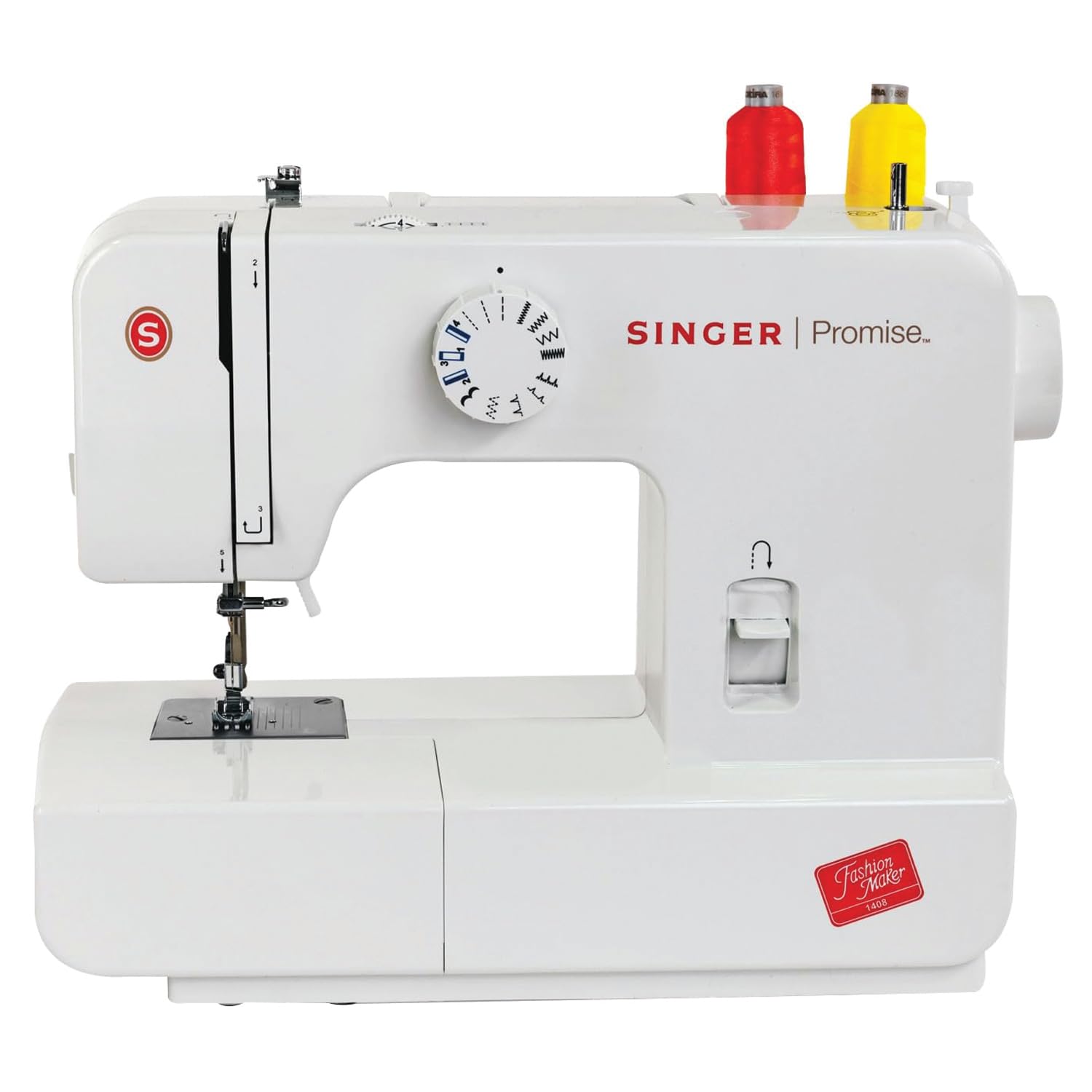
The SINGER 1408 Sewing Machine is designed for home users who want something simple enough to learn quickly but capable enough for regular alterations, hobby sewing and basic garment work.
Its core feature set is practical: 8 built-in stitches, 21 stitch functions, an 800 SPM sewing speed, 4-step buttonhole, free arm, reverse stitching, adjustable thread tension and an internal metal frame. The machine also uses a straightforward stitch-selection dial instead of electronic menus.
Customer feedback is mostly positive. The supplied Amazon data shows a 4.2 out of 5 rating from more than 4,700 global ratings, with 56% five-star and 25% four-star ratings.
The main strengths are ease of use, portability, good basic stitching and suitability for beginners. The main weaknesses are more specific: thick fabrics are not its strongest area, thread breaking or tangling appears repeatedly in customer feedback, and Singer’s demo or service experience is inconsistent.
Check the Latest SINGER 1408 Price on Amazon
Why the SINGER 1408 Works Well for Beginners
The strongest theme across customer feedback is beginner suitability.
Several first-time users describe the machine as easy to understand and straightforward enough to start making real projects rather than only practicing stitches.
Owners mention using it for:
- tote bags
- skirts
- crop tops
- sundresses
- basic alterations
- repairs
- hobby projects
The controls are mechanical and simple.
Instead of navigating a screen, you choose stitches using a dial. Reverse sewing has a dedicated control, and the pedal handles speed.
That simplicity makes the SINGER 1408 much less intimidating than machines overloaded with dozens of settings.
8 Built-In Stitches Are Enough for Most Basic Home Work
The SINGER 1408 provides 8 built-in stitches and 21 stitch functions.
That may sound modest next to machines advertising 30, 50 or 100 stitches, but most beginners and casual home users repeatedly rely on only a handful of stitch types.
For common sewing tasks, the machine covers the essentials:
- straight stitching
- zig-zag stitching
- basic decorative work
- seam reinforcement
- hemming
- buttonholes
- repairs
This makes the 1408 better suited to someone who wants useful functionality rather than a long specification sheet.
The 800 SPM Speed Is Fast Enough Without Feeling Excessive
The listed maximum speed is 800 stitches per minute.
That is noticeably quicker than many entry-level machines while still being manageable for household sewing.
For a beginner, this matters because speed should be controllable rather than simply high.
Customer feedback generally describes the pedal as responsive and easy enough to manage.
The 800 SPM capability is particularly useful when sewing longer seams or repetitive projects, while beginners can still slow down for:
- corners
- curves
- hems
- detailed work
The Metal Internal Frame Adds Stability
One feature worth separating from marketing language is the metal internal frame.
The exterior still includes plastic components, but the product listing specifies a heavy-duty metal internal frame.
That helps the machine feel more stable on a table than an extremely lightweight mini sewing machine.
Several users describe it as compact enough to move but heavy enough to remain reasonably steady while sewing.
That is a good combination for home use.
It should not, however, be interpreted as meaning the whole machine is an industrial metal machine.
The 1408 remains a domestic sewing machine.
Portability Is a Real Advantage
Several buyers specifically mention being able to move the machine around the house or take it between locations.
That makes it suitable for people who:
- do not have a permanent sewing room
- store the machine after each use
- live in smaller apartments
- move frequently
- want a machine for occasional hobby work
Some owners call it lightweight, while others describe it as slightly heavy but still portable.
That is probably the most accurate description: portable enough for home use without feeling toy-like.
The Free Arm Is Very Useful for Alterations
The removable accessory section creates a free arm.
This matters when sewing:
- sleeves
- cuffs
- trouser legs
- children’s clothing
- narrow circular openings
For home alterations, the free arm may be more useful than several decorative stitches.
It allows tubular parts of garments to fit around the machine more naturally.
The Stitch Selector Is Simple and Intuitive
Built-in stitches are displayed on the selector dial.
You simply turn the dial to the stitch you want.
There is little setup involved compared with computerized machines.
For someone learning to sew, this removes one layer of complexity.
A new user can focus on:
- fabric handling
- threading
- seam control
- pedal speed
- tension
rather than trying to understand a digital interface.
The 4-Step Buttonhole Is Useful, but Not Fully Automatic
The SINGER 1408 includes a 4-step buttonhole function.
This is useful for:
- shirts
- dresses
- children’s clothing
- cushion covers
- basic garment projects
A four-step buttonhole requires the user to move through the different stages manually.
It is therefore less convenient than a one-step buttonhole system, but it still gives beginners a structured method for making buttonholes.
One older customer did report that the buttonhole quality was not ideal on their unit, so it is worth practicing on scrap fabric before sewing directly onto a finished garment.
The Included Light Helps With Everyday Sewing
The machine has a light near the needle.
This is particularly useful for:
- dark fabrics
- evening sewing
- detailed stitching
- following marked seam lines
Several users specifically appreciated this feature.
A built-in light is not glamorous, but it is one of those features that improves nearly every sewing session.
The Thread Cutter Is Another Small Convenience
A thread cutter is built into the side of the machine.
That means you do not always need to grab scissors at the end of each seam.
For frequent sewing, these small conveniences add up.
The Bobbin System Is Generally Easy to Understand
Several users describe bobbin winding and bobbin changing as straightforward.
For a beginner, that matters because bobbin setup is one of the first areas where frustration can appear.
The manual appears to help users understand:
- winding the bobbin
- inserting the bobbin
- tension
- stitch settings
More experienced buyers also mention that factory tension settings often work well on common fabrics without major adjustments.
Thread Breaking and Tangling Are the Most Important Recurring Complaints
This is the issue that deserves the most attention.
Multiple owners report:
- thread breaking repeatedly
- thread becoming stuck
- thread collecting underneath the fabric
- needle becoming stuck near the bobbin area
- stitching becoming inconsistent
Amazon’s own customer-summary data also highlights thread durability and thread management as recurring concerns.
That does not mean every SINGER 1408 has a thread problem.
Many owners report smooth long-term use.
But the repetition is strong enough that new buyers should understand proper setup before assuming the machine is defective.
Thread problems can come from:
- incorrect threading
- unsuitable needle
- incorrect tension
- poor-quality thread
- incorrectly fitted bobbin
- forcing thick fabric
If repeated breaking continues after correct setup, the machine should be checked rather than endlessly changing settings.
Thick Fabric Is Not the 1408’s Strongest Area
This is another clear pattern.
A long-term owner who otherwise praised the machine specifically said it was not suitable for thicker-than-average fabrics such as heavy cotton or denim.
Another experienced user reported problems when sewing denser or layered material.
There are also reports of:
- needles breaking on heavier fabric
- fabric being pulled into the plate
- the machine struggling with multiple layers
So while the product title mentions a heavy-duty metal frame, that should not be confused with heavy-duty fabric capability.
The metal frame describes structural construction.
It does not automatically mean the motor, feed system and presser-foot arrangement are designed for continuous denim or upholstery work.
Best Fabrics for the SINGER 1408
Customer experience suggests the machine is most comfortable with ordinary household fabrics such as:
- cotton
- rayon
- polyester blends
- lighter garment materials
- standard dressmaking fabrics
Some users have also worked successfully with thin silk.
Performance becomes more inconsistent as fabric gets:
- very thick
- heavily layered
- unusually delicate
- difficult to feed
One long-term owner specifically found both heavy denim and delicate satin less suitable because presser-foot pressure cannot be adjusted.
That is an important limitation.
No Presser-Foot Pressure Adjustment Limits Fabric Flexibility
The lack of adjustable presser-foot pressure is one reason the 1408 is better for standard fabrics than unusual ones.
Different fabrics sometimes need different pressure levels to feed properly.
Without that adjustment, the machine relies more heavily on its factory setup.
For everyday cotton and common garment fabric, that may be fine.
For thick seams or slippery delicate fabric, control becomes more limited.
This is probably one of the most meaningful reasons not to buy the 1408 for ambitious fabric experimentation.
Needle Breakage Usually Appears Around Heavy or Incorrect Sewing
Several users mention bending or breaking needles.
In at least some cases, the buyers themselves linked this to:
- heavy fabric
- incorrect settings
- learning mistakes
The good news is that needle replacement is normal sewing-machine maintenance.
The concern is when breakage happens repeatedly during ordinary fabric sewing.
A beginner should avoid forcing fabric through the machine.
The feed mechanism should move the fabric; pulling or pushing aggressively can increase the chance of needle damage.
It Is Better for Hobby Sewing Than Professional Tailoring
The 1408 fits hobby and household work much better than continuous commercial sewing.
It is well suited to:
- basic clothing projects
- repairs
- alterations
- tote bags
- home craft work
- learning to sew
It is less suitable for:
- professional tailoring
- heavy denim
- upholstery
- thick curtains
- many layers
- high-volume production
One experienced owner explicitly said it was excellent for small home-sewing needs but not for a professional or more adventurous hobbyist.
That is a fair summary of the machine’s position.
Long-Term Durability Can Be Very Good
Not all customer feedback is short-term.
One buyer reported using the machine successfully for five years.
Another long-term review described more than two years of reliable use for ordinary home work.
That is encouraging because it suggests the machine is capable of lasting when:
- used within its intended workload
- maintained properly
- not forced through heavy material
- threaded correctly
The mixed reliability feedback appears to come more from certain individual units, thread-management problems and service experiences rather than universal short lifespan.
Some Buyers Report Defective or Used-Looking Units
There are isolated but important complaints involving:
- machines not feeding fabric
- jammed hand wheels
- broken internal components
- used-looking machines
- defective units on arrival
One buyer received a machine that appeared used and requested a replacement.
Another reported a brand-new unit that could not move fabric correctly until a technician examined it.
These experiences are not representative of the majority, but they justify testing the machine promptly after delivery.
What to Test Immediately After Delivery
Before the return or replacement period becomes an issue, check:
- the hand wheel moves freely,
- the pedal responds normally,
- fabric feeds forward correctly,
- straight stitch is even,
- zig-zag works properly,
- reverse stitching works,
- the bobbin winds normally,
- thread does not repeatedly jam,
- the light works,
- all listed accessories are present.
Test with ordinary cotton first.
Do not begin by feeding thick denim through a new machine and judging it from that.
Singer’s Free Home Demo Sounds Better on Paper Than It Works for Everyone
The current listing advertises a free home demo after registering purchase details on Singer’s website.
Some recent buyers report positive experiences with Singer assistance.
One customer specifically appreciated Singer Live Assist guidance and said it made operation easier.
Others had a very different experience.
Complaints include:
- long waits for demo
- repeated calls
- invalid or unhelpful contact numbers
- limited demo sessions
- difficulty getting service
One owner said the demo took around a month to arrange.
So the service experience appears to depend heavily on location and timing.
Do not assume the demo will always happen immediately.
After-Sales Service Is a More Serious Weakness Than the Basic Machine Design
Some of the harshest reviews concern support rather than the sewing capability itself.
There are reports involving:
- technician delays
- paid repair confusion
- poor communication
- unresolved stitching issues
- dissatisfaction after warranty-related visits
At the same time, other buyers successfully received service and guidance.
The reasonable takeaway is that Singer support is inconsistent rather than universally poor.
Buyers who live far from a Singer service location may want to verify local service access before ordering.
The Two-Year Warranty Is Useful
The product listing specifies a 2-year warranty.
The package information indicates that the user manual also functions as the warranty card.
Some buyers report missing warranty documentation, so verify this as soon as the machine arrives.
Keep your:
- Amazon invoice
- user manual
- warranty information
- order details
stored safely.
The Accessory Set Covers Basic Sewing, but Not Everything
The listing says the package includes:
- sewing machine
- accessories box
- foot pedal
- user manual/warranty card
Customer feedback indicates the included sewing feet and accessories cover many basic tasks.
However, some buyers point out that items such as:
- measuring tape
- scissors
- extra thread
- additional specialty feet
- certain small sewing tools
may still need to be purchased separately.
That is normal for many sewing machines, but beginners should budget a little extra for a basic sewing kit if they do not already own one.
Check the Current SINGER 1408 Package Contents on Amazon
Cable Length May Be Annoying in Some Setups
One detailed long-term review mentioned that the cable felt too short.
This is not a major defect, but it matters if the sewing table is not close to a power socket.
A safe extension arrangement may be necessary depending on your workspace.
The Rating Distribution Is Strong Overall
The Amazon snapshot shows:
- 56% five-star
- 25% four-star
- 8% three-star
- 2% two-star
- 9% one-star
That means 81% of ratings are four or five stars.
The positive feedback is concentrated around:
- beginner suitability
- ease of use
- basic stitch quality
- portability
- value for money
- home sewing
The negative feedback most often involves:
- thread breaking
- thread tangling
- poor fabric feeding on some units
- thick-fabric limitations
- service and demo issues
- defective or poorly handled units
That is a reasonably clear ownership picture.
Is the SINGER 1408 Good for Beginners?
Yes.
This is probably the strongest reason to buy it.
The controls are easy to understand, the speed is manageable, the stitch selection covers common needs and the machine is portable enough for home use.
A beginner can realistically progress from basic repairs into:
- skirts
- simple dresses
- tote bags
- hems
- decorative stitching
- basic garment construction
without immediately needing another machine.
Is It Good for Experienced Sewers?
It depends on the workload.
An experienced sewer who mainly wants a secondary machine for repairs and lighter home work may appreciate its simplicity.
Someone working regularly with:
- heavy fabrics
- multiple layers
- advanced garment techniques
- professional workloads
will probably find its limitations more quickly.
Who Should Consider the SINGER 1408?
It is best suited to:
- beginners
- hobby sewists
- household alterations
- light garment making
- basic repairs
- users who value portability
- people who want a simple mechanical electric machine
Who Should Choose Something Else?
Consider another model if your priority is:
- regular denim sewing
- thick layered garments
- upholstery
- heavy canvas
- professional tailoring
- adjustable presser-foot pressure
- advanced decorative stitching
- computerized features
For those users, paying more for a stronger machine is likely to save frustration.
Is the SINGER 1408 Worth Around ₹11,259?
The captured Amazon listing showed the SINGER 1408 at approximately ₹11,259, against an MRP of ₹16,800.
At that price, the machine has a reasonable value proposition for beginners and home users.
You are getting:
- 8 built-in stitches
- 21 stitch functions
- 800 SPM sewing
- 4-step buttonhole
- free arm
- metal internal frame
- reverse sewing
- tension adjustment
- portable domestic design
- 2-year warranty
The important comparison is with nearby models.
The captured listing showed the SINGER 1310 priced only slightly higher at the time, with a somewhat broader stitch specification.
If the price difference between the 1408 and a more capable Singer model is very small, compare both before ordering.
Check the Current SINGER 1408 Price and Seller Details on Amazon
Final Assessment
The SINGER 1408 is a sensible beginner and home-sewing machine when used within its intended limits.
Its strengths are straightforward:
- simple controls
- manageable 800 SPM speed
- useful everyday stitches
- free-arm sewing
- portable design
- stable metal internal frame
- good basic sewing performance
The limitations are equally clear.
It is not a true heavy-fabric machine, despite the metal-frame description. Thick denim, dense multilayer seams and some delicate fabrics can expose its limitations.
Thread breaking and tangling also appear often enough in customer feedback that correct setup matters. Buyers should learn threading, bobbin placement and tension carefully before deciding something is wrong with the machine.
Service is another variable. Some users receive helpful guidance, while others struggle to arrange demos or repairs.
For beginners, hobby users and people who mainly want to handle everyday household stitching, the SINGER 1408 remains a practical option.
For heavy or professional sewing, choosing a stronger machine from the outset is the better approach.
View the SINGER 1408 on Amazon and Check Its Latest Availability