Usha Janome Stitch Magic Review: A Powerful 57-Function Sewing Machine for Serious Home Sewers, but Service Support Is Its Biggest Weakness
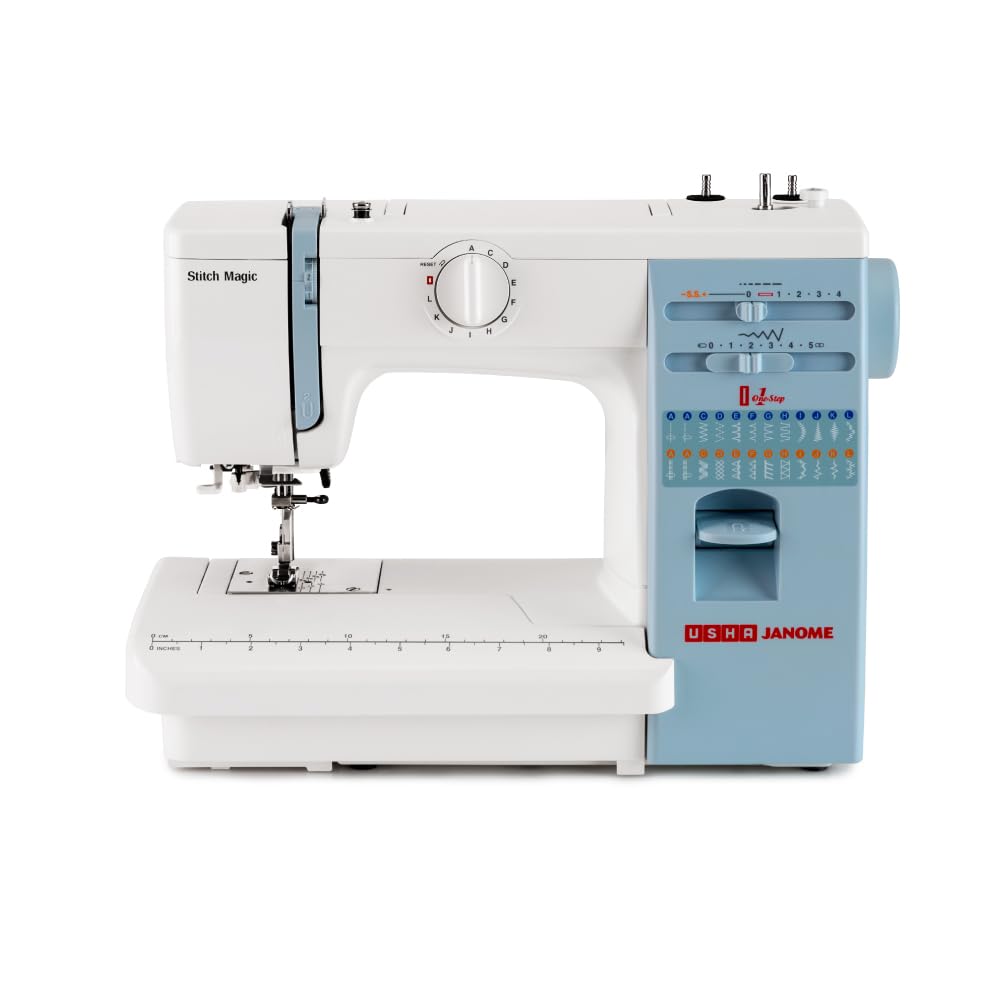
The Usha Janome Automatic Stitch Magic Sewing Machine is a much more capable machine than a basic home sewing model.
Its headline feature is obvious: 57 stitch functions. But the real reason to consider it is the combination of stitch variety, 860 SPM sewing speed, free-arm sewing, manual tension control, triple-strength stitching, multiple presser feet and the ability to handle both ordinary garment work and more creative sewing.
This is also a more expensive machine than beginner-focused Usha Janome models. The captured Amazon listing showed the Without KIT version at around ₹21,799, while the With KIT variant was around ₹25,369.
At that price, the Stitch Magic needs to offer more than just extra decorative stitches.
Customer feedback suggests that it does. Experienced sewers often praise its versatility, stitching quality, speed and long-term usefulness. Some owners report using the model successfully for years.
The biggest problem is not really the core sewing capability.
It is after-sales support.
Complaints about delayed demos, poor communication and technicians not arriving appear repeatedly enough that buyers should take them seriously.
Check the Latest Usha Janome Stitch Magic Price on Amazon
This Machine Makes the Most Sense for Someone Who Will Actually Use Its Extra Functions
The Stitch Magic offers 57 stitch functions.
That immediately places it above simpler Usha Janome machines designed primarily for repairs, basic garment sewing and occasional decorative work.
The listed applications include functions for:
- stretch stitching
- button fixing
- rolled hemming
- satin stitching
- zipper fixing
- smocking
- blind hemming
- decorative stitching
- reinforced seams
This is not a machine where most buyers will necessarily use every available stitch.
In fact, one experienced owner made a useful point: many of the decorative patterns may be unnecessary if the buyer mainly performs ordinary straight stitching.
That is important.
If your sewing needs are limited to:
- small repairs
- simple hems
- occasional alterations
- basic straight stitching
then paying for 57 stitch functions probably does not make much sense.
The Stitch Magic becomes much more compelling when the owner wants to make garments, experiment with patterns or develop more advanced sewing skills.
It Is Better Suited to Experienced Sewers Than Absolute Beginners
Customer experiences are slightly divided here.
Some owners describe the Stitch Magic as easy to operate and say even beginners can learn it successfully.
Others feel the large number of settings makes it unnecessarily complicated for someone who only wants a simple household sewing machine.
Both views are reasonable.
The controls themselves are not particularly complicated. The machine uses dial-style selectors rather than a digital computer interface.
But a beginner still has to understand:
- stitch selection
- stitch length
- tension
- different presser feet
- bobbin setup
- threading
- fabric choice
- needle selection
- pedal speed
When you add 57 functions, there is simply more to learn.
For someone serious about sewing, that is a benefit.
For someone who wants a machine only for quick household repairs, it may feel excessive.
Experienced Sewers Get More Value From the Stitch Magic
One of the strongest reviews came from an experienced seamstress who had been making clothes for years.
Her experience highlights where the Stitch Magic fits best.
The machine allows users to switch between different fabrics, styles and stitch settings without immediately running into the limitations of a basic model.
Another buyer described it as particularly suitable for designers.
That gives a clearer picture of the ideal user:
someone who already understands sewing or intends to learn beyond the basics.
The 860 SPM Speed Makes It More Capable for Frequent Sewing
The listing specifies a sewing speed of approximately 860 stitches per minute.
That is noticeably faster than many entry-level home machines.
The additional speed matters when working on:
- long garment seams
- curtains
- repeated sewing projects
- boutique-style work
- regular household sewing
One owner specifically liked the combination of foot control and slower manual control for more detailed work.
The foot pedal handles normal sewing speed, while slower control can be useful for more precise sections.
That makes the Stitch Magic more versatile than a machine that only feels comfortable at one pace.
The Free Arm Helps With Real Garment Construction
The machine includes a free arm with a detachable extension bed.
This makes it easier to work on circular areas such as:
- trouser legs
- cuffs
- sleeves
- children’s garments
- narrow clothing sections
This may sound like a small feature, but garment makers use it regularly.
It is particularly useful for anyone planning to do more than flat seams and basic repairs.
Triple-Strength Stitching Adds Practical Reinforcement
The Stitch Magic includes a triple-strength stitch.
This is useful in places where seams need more reinforcement.
Examples may include:
- areas under greater stress
- certain stretch fabrics
- garment seams that receive frequent pulling
- projects where standard straight stitching feels insufficient
This does not make the machine industrial, but it gives the user more options than a standard straight stitch alone.
Stitch Length and Pattern Selection Are Controlled Separately
The machine uses two dials, one for pattern selection and one for stitch length.
That is a useful arrangement because it keeps the controls mechanical and visible.
A user can change a stitch without navigating menus.
For experienced sewing-machine users, this type of control often feels more direct than a computerized interface.
It also reduces some of the learning curve compared with more advanced digital machines.
The Stitch Magic Can Handle a Wide Range of Fabrics, but Expectations Should Still Be Sensible
The product listing describes the machine as capable of smooth operation on different fabrics.
Several long-term users also report good performance across different materials.
One experienced owner described using the machine successfully for a wide range of stitching.
Another customer said the machine had worked well for both daily household sewing and small boutique use.
That is encouraging.
However, claims about fabric handling should still be interpreted realistically.
A domestic sewing machine is not automatically equivalent to an industrial heavy-duty machine.
The Stitch Magic appears stronger and more capable than many entry-level models, but buyers planning constant work on:
- very thick denim
- upholstery
- dense canvas
- multiple heavy layers
should still consider a dedicated heavy-duty machine.
The Machine Feels More Substantial Than Cheaper Models
Several owners mention the machine’s heavier construction.
One experienced user described a metal body or metal frame, noting that the additional weight reduced vibration.
Another buyer described an aluminium main frame with good-quality plastic exterior construction.
This is useful because the Stitch Magic does not feel like a lightweight mini sewing machine.
The trade-off is obvious:
more stability means less portability.
It still has a carrying handle, but if you expect to move the machine constantly from room to room, the weight may become noticeable.
For someone with a permanent sewing table, that is less of a concern.
Portability Is Still Reasonable
Despite the more substantial construction, several buyers describe the Stitch Magic as compact and portable enough for home use.
The carrying handle makes occasional moving easier.
This means it fits somewhere between:
- lightweight beginner machines
- large traditional tailor machines
It is suitable for a home sewing area without requiring the permanent table setup of an industrial machine.
The Included Hard Cover Is Useful
Several owners appreciated receiving a hard cover.
That is a simple but practical addition.
A hard cover helps protect the machine from:
- dust
- accidental knocks
- long periods of storage
For a machine costing over ₹20,000, proper storage matters.
One recent review, however, specifically mentioned that the machine cover’s build quality could be improved.
That appears to be a smaller complaint rather than a widespread problem.
The Accessory Package Covers the Basics
The current listing describes 10 free accessories, including:
- zig-zag foot
- blind hem foot
- zipper foot
- sliding buttonhole foot
- round hemmer foot
- darning plate
- bobbin
- seam ripper
- needle set
- thread spools
- screwdriver
These accessories are stored in the machine’s accessory compartment.
For ordinary garment sewing, that is a useful starting set.
More specialized feet can be purchased separately if required.
Some Buyers Still Report Missing Accessories
Missing items are not as dominant a problem here as with some other sewing-machine listings, but they do appear.
Customers have reported:
- missing basic accessories
- missing parts
- missing spool pins
- missing warranty cards
The machine may still work perfectly even when something is missing, but that does not mean an incomplete package should be accepted.
Check the accessory compartment as soon as the machine arrives.
Do not assume that a missing item was simply not included with your variant.
Check Current Package Contents and Seller Details on Amazon
Warranty Documentation Can Be Confusing
The listing states that the machine has a 2-year manufacturer’s warranty and that the Amazon invoice should be sufficient for a claim.
That is useful because several reviews mention missing warranty cards.
One customer even received both the original machine and its replacement without a warranty card.
If the Amazon invoice is accepted for warranty claims, the missing card should not necessarily leave the buyer without coverage.
Still, keep all documentation and order details safely.
The Sewing Lessons Are Useful Because Demo Support Is Unreliable
The product listing promotes complimentary sewing lessons through Usha’s resources.
That is particularly relevant with this model because many buyers complain about the home-demo experience.
Online learning resources can help users understand:
- threading
- bobbin loading
- tension
- pattern selection
- foot changes
- decorative stitches
- maintenance
There are also many user-generated videos available for this model.
That may matter more than the advertised demo service because some buyers waited days or weeks for a technician.
After-Sales Support Is the Biggest Weakness
This is the most repeated negative theme.
There are numerous complaints involving:
- technicians not arriving
- demo appointments being delayed
- repeated customer-care calls
- poor follow-up
- unavailable home support
- service centres requiring visits instead of home service
Some customers report waiting more than a week.
Others say they never received the promised demo at all.
A few buyers specifically warn that users unfamiliar with the machine should not rely on getting quick in-person help after buying online.
This matters more with the Stitch Magic than with a basic sewing machine because there are many more functions to understand.
Service Quality Clearly Varies by Location
Not every customer had a poor experience.
Some reviews describe satisfactory service.
One owner said the machine was easy to use and service was good.
Another long-term owner noted that home servicing may be available depending on location.
That suggests support is highly regional.
Before ordering, it is worth checking whether an authorized Usha Janome service centre is actually accessible in your area.
Someone living near a good service centre may have a completely different ownership experience from someone relying on repeated home visits.
A Few Buyers Experienced Early Mechanical Problems
There are some reports of faults appearing relatively soon after purchase.
Examples include:
- presser-foot lifter failure
- stitching problems within days
- mechanical noise
- repairs within several months
- bobbin thread pickup problems
These complaints are important but should not be treated as universal.
There are also long-term owners reporting four, five or even around ten years of use.
The evidence therefore points more toward variation between individual units and ownership experiences than a clear universal durability problem.
Long-Term Feedback Is Actually One of the More Encouraging Signs
Several owners report very long periods of use.
One buyer said the same model had been used for roughly ten years.
Another described more than four years of successful use.
That kind of feedback suggests the Stitch Magic can be a durable machine when:
- the unit is good,
- it is maintained properly,
- and it is used within reasonable limits.
For buyers concerned about paying more than ₹20,000, long-term successful ownership is much more meaningful than a short one-week review.
Cleaning and Maintenance Matter
One experienced customer specifically pointed out that the machine needs regular cleaning and maintenance.
That makes sense for a machine offering many stitch functions and mechanical controls.
Basic maintenance should include:
- removing lint
- cleaning around the bobbin area
- replacing worn needles
- using appropriate thread
- storing the machine covered
- following lubrication guidance in the manual
- avoiding forcing heavy fabric
A feature-rich domestic machine is not maintenance-free.
Automatic Buttonhole Performance May Need Fine-Tuning
One customer reported that the automatic buttonhole foot produced denser stitching on one side than the other.
That appears to be limited evidence rather than a widespread defect.
Still, garment makers should test the buttonhole function on scrap fabric before using it on a finished project.
Buttonhole quality can depend on:
- fabric type
- tension
- stabilizer
- thread
- correct foot setup
So uneven results may not always mean the machine is faulty.
Some Users Find the Machine Noisier Than Expected
Feedback on noise is mixed.
Some owners describe the Stitch Magic as smooth and quiet.
Another recent buyer reported abnormal mechanical noise and returned the first unit.
A different buyer thought the machine was somewhat noisy but was unsure whether their unit had a problem.
This suggests that noticeable unusual noise should not automatically be accepted as normal.
A healthy unit is frequently described as smooth.
If a newly delivered machine produces harsh mechanical sounds, testing or replacement may be sensible.
Inspect the Machine During the Return Window
Because there are occasional reports of defective units, missing parts and abnormal noise, the machine should be tested promptly after delivery.
Check:
- straight stitching,
- zig-zag and decorative patterns,
- bobbin pickup,
- pedal speed,
- slower control,
- stitch-length adjustment,
- presser-foot lifter,
- buttonhole operation,
- free-arm setup,
- unusual vibration or noise.
Do this before assuming a promised technician will arrive.
Waiting too long for a demo can make returns more complicated.
The 57 Functions Do Not Automatically Make It Better for Everyone
More features are only valuable when you use them.
One buyer who mainly performed normal stitching felt that the large number of decorative options was unnecessary.
This is probably the most important value question.
Someone who uses only:
- straight stitch
- zig-zag
- occasional buttonholes
may get better value from a cheaper Usha Janome model.
Someone regularly sewing:
- garments
- decorative patterns
- different fabric styles
- boutique projects
has a stronger reason to choose the Stitch Magic.
It Can Make Sense for Small Boutique Work
Long-term customer feedback describes the machine as suitable for both household sewing and small boutique use.
The 860 SPM speed, stitch selection and variety of feet support this use case.
But “small boutique use” should not be confused with industrial production.
For occasional customer garments and creative work, it may be practical.
For continuous eight-hour daily operation, a professional industrial setup remains more appropriate.
What the Customer Rating Pattern Shows
The supplied Amazon data shows a 4.1 out of 5 rating from 1,072 global ratings, with:
- 59% five-star
- 19% four-star
- 8% three-star
- 3% two-star
- 11% one-star
That means 78% of ratings fall in the four- or five-star range.
The positive reviews tend to focus on:
- stitch quality
- feature variety
- ease of use
- speed
- value
- long-term durability
- designer and boutique usefulness
The negative reviews focus more heavily on:
- service and demo problems
- missing accessories
- occasional mechanical faults
- missing warranty documentation
- noise on some units
The unusual thing about this machine is that customer support generates stronger criticism than the sewing functionality itself.
Is the Usha Janome Stitch Magic Good for Beginners?
It can be, but it is not necessarily the smartest first machine for every beginner.
A motivated beginner who intends to learn garment sewing and creative techniques may appreciate having extra functions available.
A casual beginner who just wants basic repairs is probably paying for many features that may never be used.
The machine makes more financial sense when the buyer expects to grow into it.
Is It Good for Experienced Sewers?
Yes. This is arguably its strongest audience.
Experienced users are more likely to make use of:
- multiple stitch patterns
- triple-strength stitching
- different presser feet
- buttonholes
- free-arm sewing
- decorative techniques
- stitch-length control
They are also less dependent on the inconsistent demo service.
Who Should Consider the Stitch Magic?
It is best suited to:
- experienced home sewers
- intermediate users
- serious beginners
- garment makers
- hobby designers
- light boutique users
- people upgrading from a basic zig-zag machine
- users who genuinely want a large stitch selection
Who Should Probably Buy Something Simpler?
A cheaper model may be better for:
- occasional repairs
- basic hemming
- simple straight stitching
- very infrequent sewing
- complete beginners who want minimum controls
Spending more than ₹20,000 simply for a higher stitch count does not make sense if those functions will never be used.
Is the Usha Janome Stitch Magic Worth ₹21,799?
The captured listing showed the Without KIT version at around ₹21,799, against an MRP of ₹23,750.
The With KIT version was around ₹25,369.
At that price, the Stitch Magic sits in a much more competitive range than entry-level sewing machines.
Its value comes from:
- 57 stitch functions
- 860 SPM speed
- triple-strength stitching
- free arm
- multiple sewing feet
- broad fabric versatility
- stable construction
- long-term growth potential
However, buyers should compare it carefully with other models around ₹20,000.
The supplied Amazon page itself showed alternatives with fewer or more advanced functions at similar prices.
If the Stitch Magic is discounted into the ₹18,000–₹19,000 range, the value proposition becomes more attractive.
At full price, buyers should be confident that they genuinely need its additional capabilities.
Check the Current Usha Janome Stitch Magic Price and Variants on Amazon
Final Assessment
The Usha Janome Stitch Magic is a capable step-up sewing machine rather than a basic household appliance.
Its 57 stitch functions, 860 SPM speed, triple-strength stitch, free arm and accessory selection give experienced users enough flexibility for garment making, decorative work and small boutique projects.
The positive feedback around stitching, smoothness and long-term use is encouraging.
But two things should influence the buying decision.
First, many casual users simply do not need this many functions. If most of your sewing is basic repair work, a cheaper model will probably offer better value.
Second, Usha’s demo and after-sales support receive repeated criticism. Buyers who rely heavily on technician guidance should verify local service availability before purchasing online.
For an experienced sewer, designer or serious home user who wants a machine with room to grow, Stitch Magic is a strong option.
For someone who only needs a handful of basic stitches, it is more machine—and more money—than necessary.
View the Usha Janome Stitch Magic on Amazon and Check Latest Availability